


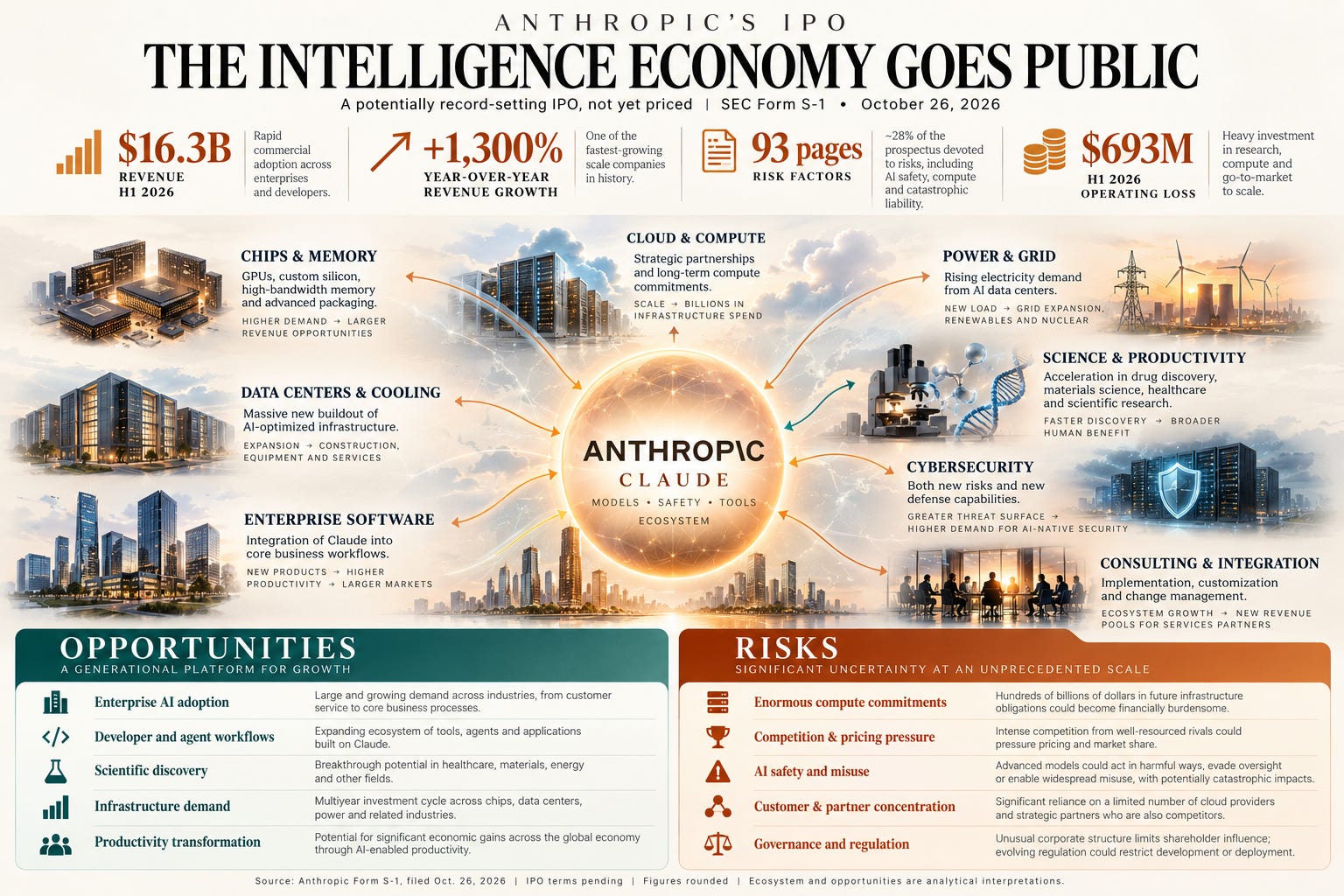
Anthropic’s IPO is not simply another blockbuster technology offering. It may mark a fundamental turning point in capitalism itself: the moment intelligence begins its transformation from a scarce human capability into an industrial-scale, commercially produced resource. Just as electricity transformed virtually every industry in the 20th century, artificial intelligence is emerging as a foundational input to economic activity, one that can be manufactured, distributed, embedded in products, and deployed at extraordinary scale. Anthropic’s explosive growth is an early signal of this transition, but the real story is the vast economic ecosystem forming around it: semiconductors, data centers, electricity generation, enterprise software, autonomous agents, scientific discovery, and entirely new business models. The IPO offers investors a rare glimpse into the infrastructure being assembled to power what may become an entirely new economic order.
Yet there is a profound paradox at the heart of this transformation. We are investing unprecedented amounts of capital to manufacture a form of intelligence whose ultimate capabilities, economic value, and consequences we cannot reliably predict. Anthropic’s extensive risk disclosures reveal just how much remains unresolved, from the economics of massive compute commitments to the governance and safety of increasingly autonomous systems. This is what makes the IPO historically significant: it is simultaneously a bet on extraordinary productivity and a public acknowledgment of extraordinary uncertainty. The question is no longer simply whether AI will become a major industry. It is who will control the infrastructure of intelligence, who will capture the value it creates, and whether our institutions can adapt as quickly as the technology itself.