



Deep Gap Journal Update: In the coming weeks and months I will be publishing a series of articles, papers, podcasts and videos on this Substack channel. These will cover a wide range of topics but the overall thrust will be to explore AI's economic and social impact. My mission will be to help readers and listeners not only understand AI better but to harness its power. I have been developing content for several months already and I can tell you that there is some MIND-BLOWING stuff coming your way. The infographic below and the paper that appears further down is an example…
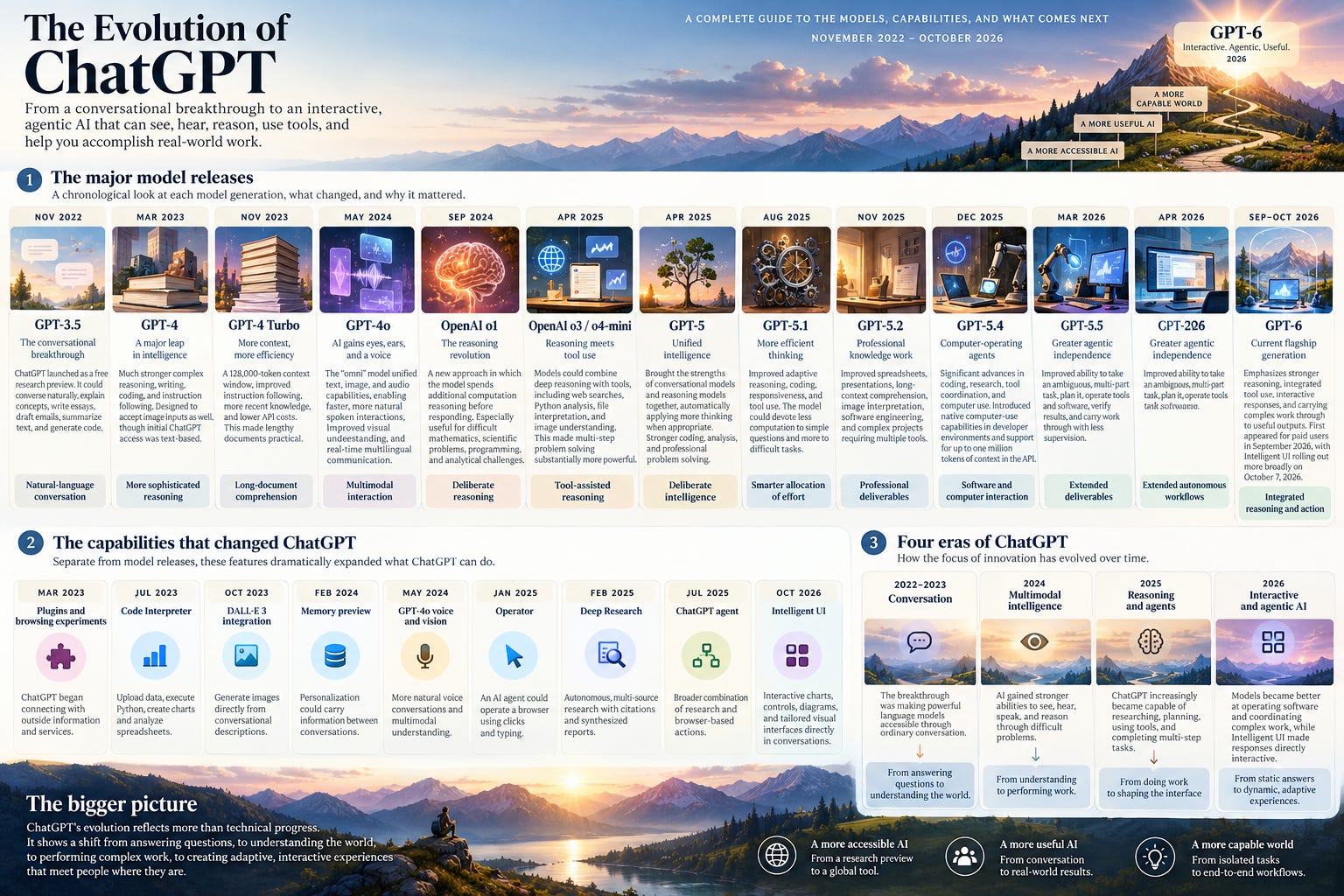
GPT-6 Intelligent UI release
This month, OpenAI released ChatGPT 6. The GPT-6 Intelligent UI release represents a different kind of milestone.
Previously, software developers designed the interface and AI supplied the content. Now, ChatGPT can assemble an interface suited to the question itself.
The World’s Most Beautiful Libraries exploration is a modest example. Instead of receiving six paragraphs and six photographs, you received a navigable experience with buttons, images, facts, and a selection control.

The larger implication is that software may increasingly adapt to the user rather than requiring the user to adapt to software. That’s the direction OpenAI explicitly describes in its GPT-6 announcement.
And there’s an intriguing distinction for AI adoption, a topic I will be spending a lot of time exploring: improvements in model intelligence and improvements in usability can reinforce one another. A model doesn’t necessarily need a dramatic increase in reasoning ability to become dramatically more useful to a much larger population.
That could be one of the most consequential developments in this entire timeline.
The Evolution of ChatGPT
November 2022 – October 2026 | Models, Capabilities, and the Rise of Interactive AI
White paper | October 18, 2026
Executive perspective
ChatGPT evolved from a text-based conversational novelty into a multimodal system capable of reasoning, researching, writing software, analyzing images, and working with tools.
Two histories run in parallel: the GPT models (the underlying intelligence) and the ChatGPT capabilities layered around them, including browsing, voice, memory, image generation, data analysis, and autonomous research. A new capability does not always require a new model.
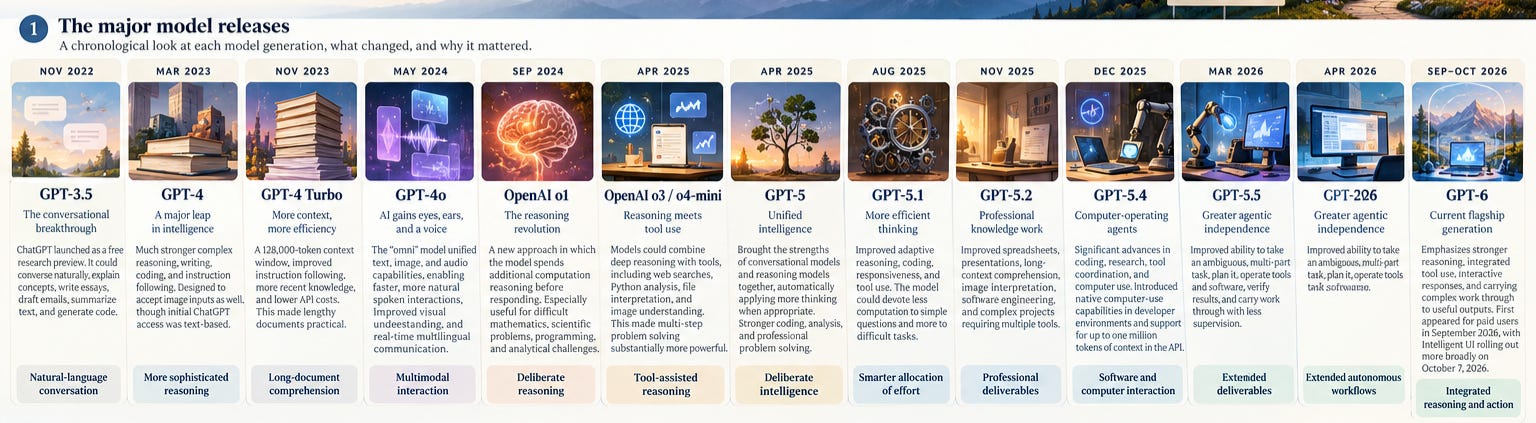
1. The major model releases
GPT-3.5 | November 2022
The conversational breakthrough
ChatGPT launched as a free research preview. It could converse naturally, explain concepts, write essays, draft emails, summarize text, and generate code. Its accessibility introduced generative AI to a mass audience.
Signature advance: Natural-language conversation
GPT-4 | March 2023
A major leap in intelligence
Much stronger complex reasoning, writing, coding, and instruction following. GPT-4 was designed to accept image inputs as well, although initial ChatGPT access was text-based.
Signature advance: More sophisticated reasoning
GPT-4 Turbo | November 2023
More context, more efficiency
A much larger 128,000-token context window, improved instruction following, more recent knowledge, and lower API costs. This made lengthy documents and more complex workflows practical.
Signature advance: Long-document comprehension
GPT-4o | May 2024
AI gains eyes, ears, and a voice
The omni model unified text, image, and audio capabilities, enabling much faster and more natural spoken interactions, improved visual understanding, and real-time multilingual communication.
Signature advance: Multimodal interaction
OpenAI o1 | September 2024
The reasoning revolution
Introduced an approach in which the model spends additional computation reasoning before responding. Particularly useful for difficult mathematics, scientific problems, programming, and analytical challenges.
Signature advance: Deliberate reasoning
OpenAI o3 / o4-mini | April 2025
Reasoning meets tool use
Models could combine deep reasoning with tools, including web searches, Python analysis, file interpretation, and image understanding. This made multi-step problem solving substantially more powerful.
Signature advance: Tool-assisted reasoning
GPT-5 | August 2025
Unified intelligence
Brought the strengths of conversational models and reasoning models together, automatically applying more thinking when appropriate. Stronger coding, analysis, and professional problem solving.
Signature advance: Adaptive intelligence
GPT-5.1 | November 2025
More efficient thinking
Improved adaptive reasoning, coding, responsiveness, and tool use. The model could devote less computation to simple questions and more to difficult tasks.
Signature advance: Smarter allocation of effort
GPT-5.2 | December 2025
Professional knowledge work
Improved spreadsheets, presentations, long-context comprehension, image interpretation, software engineering, and complex projects requiring multiple tools.
Signature advance: Professional deliverables
GPT-5.4 | March 2026
Computer-operating agents
Significant advances in coding, research, tool coordination, and computer use. Introduced native computer-use capabilities in developer environments and support for up to one million tokens of context in the API.
Signature advance: Software and computer interaction
GPT-5.5 | April 2026
Greater agentic independence
Improved the ability to take an ambiguous, multi-part task, plan it, operate tools and software, verify results, and carry work through with less supervision.
Signature advance: Extended autonomous workflows
GPT-6 | 2026 (month not independently verified)
Current flagship generation
The current GPT-6 generation emphasizes stronger reasoning, integrated tool use, interactive responses, and carrying complex work through to useful outputs. The precise initial public release month was not independently verified for this document.
Signature advance: Integrated reasoning and action
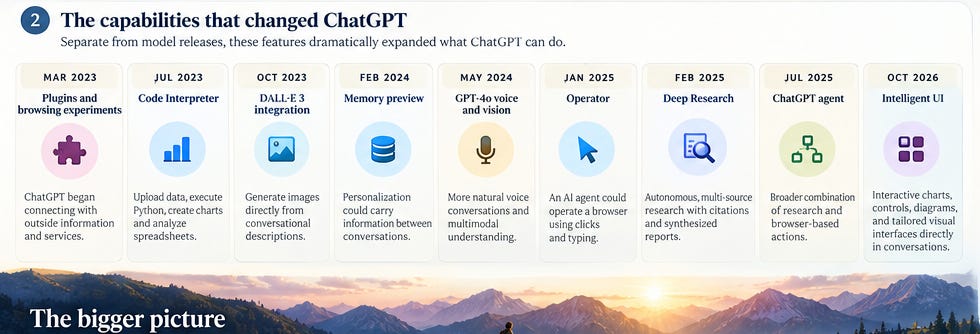
2. The capabilities that changed ChatGPT
Release
Major capability
Why it mattered
March 2023
Plugins and browsing experiments
ChatGPT began connecting with outside information and services.
July 2023
Code Interpreter
Upload data, execute Python, create charts, and analyze spreadsheets.
October 2023
DALL·E 3 integration
Generate images directly from conversational descriptions.
February 2024
Memory preview
Personalization could carry information between conversations.
May 2024
GPT-4o voice and vision
More natural voice conversations and multimodal understanding.
January 2025
Operator
An AI agent could operate a browser using clicks and typing.
February 2025
Deep Research
Autonomous, multi-source research with citations and synthesized reports.
July 2025
ChatGPT agent
Broader combination of research and browser-based actions.
October 2026
Intelligent UI
Interactive charts, controls, diagrams, and tailored visual interfaces directly in conversations.
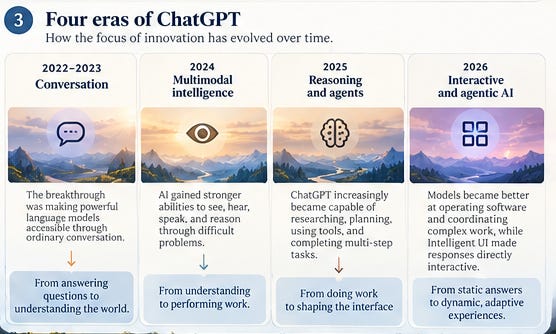
3. The bigger picture: four eras of ChatGPT
2022–2023: Conversation
The breakthrough was making powerful language models accessible through ordinary conversation.
Transition: From answering questions to understanding the world.
2024: Multimodal intelligence
AI gained stronger abilities to see, hear, speak, and reason through difficult problems.
Transition: From understanding to performing work.
2025: Reasoning and agents
ChatGPT increasingly became capable of researching, planning, using tools, and completing multi-step tasks.
Transition: From doing work to shaping the interface.
2026: Interactive and agentic AI
Models became better at operating software and coordinating complex work, while Intelligent UI made responses directly interactive.
Transition: From static answers to dynamic, adaptive experiences.
4. Why October 2026 is particularly interesting
The GPT-6 Intelligent UI experience represents a different kind of milestone. Previously, software developers designed the interface and AI supplied the content. Now, ChatGPT can assemble an interface suited to the question itself.
The library exploration offers a modest example. Instead of receiving six paragraphs and six photographs, the user received a navigable experience with buttons, images, facts, and a selection control.
The larger implication is that software may increasingly adapt to the user rather than requiring the user to adapt to software.
Improvements in model intelligence and improvements in usability can reinforce one another. A model does not necessarily need a dramatic increase in reasoning ability to become dramatically more useful to a much larger population. This may be one of the most consequential developments in the timeline.
5. Implications for adoption and interface design
The story is not simply a sequence of smarter models. It is a shift in the unit of value: from answers, to analyses, to deliverables, to workflows, and ultimately to personalized interactive experiences. Lowering the interface barrier can expand adoption independently of raw model benchmarks.
Source and verification note
This paper preserves and expands the preceding conversation. Release dates and capability descriptions are a historical overview, not a freshly audited release ledger. In particular, the prior conversation contained conflicting claims about the first public release month of GPT-6 (unverified versus September 2026). The exact GPT-6 release month and the October 2026 Intelligent UI launch claim should be checked against official release notes before external publication.
Primary sources for verification: https://openai.com/news/ ; https://help.openai.com/en/articles/6825453-chatgpt-release-notes ; https://openai.com/index/gpt-4/ ; https://openai.com/index/hello-gpt-4o/ ; https://openai.com/index/introducing-openai-o1-preview/ ; https://openai.com/index/introducing-deep-research/

