


User Interface Breakthrough
For decades, using a computer meant learning its language: commands, menus, icons, applications, and increasingly complex interfaces. The graphical user interface, pioneered at research laboratories and popularized by Apple and Microsoft in the 1980s, revolutionized computing by replacing typed commands with windows, icons, and a mouse. Smartphones later made interaction even more intuitive through touch. But ChatGPT introduced another fundamental shift: instead of requiring people to learn how to communicate with computers, computers became remarkably capable of understanding how people naturally communicate. For the first time, millions of ordinary users could engage in open-ended conversations with a computer, asking questions, expressing ideas, refining instructions, and exploring unfamiliar subjects in everyday language.
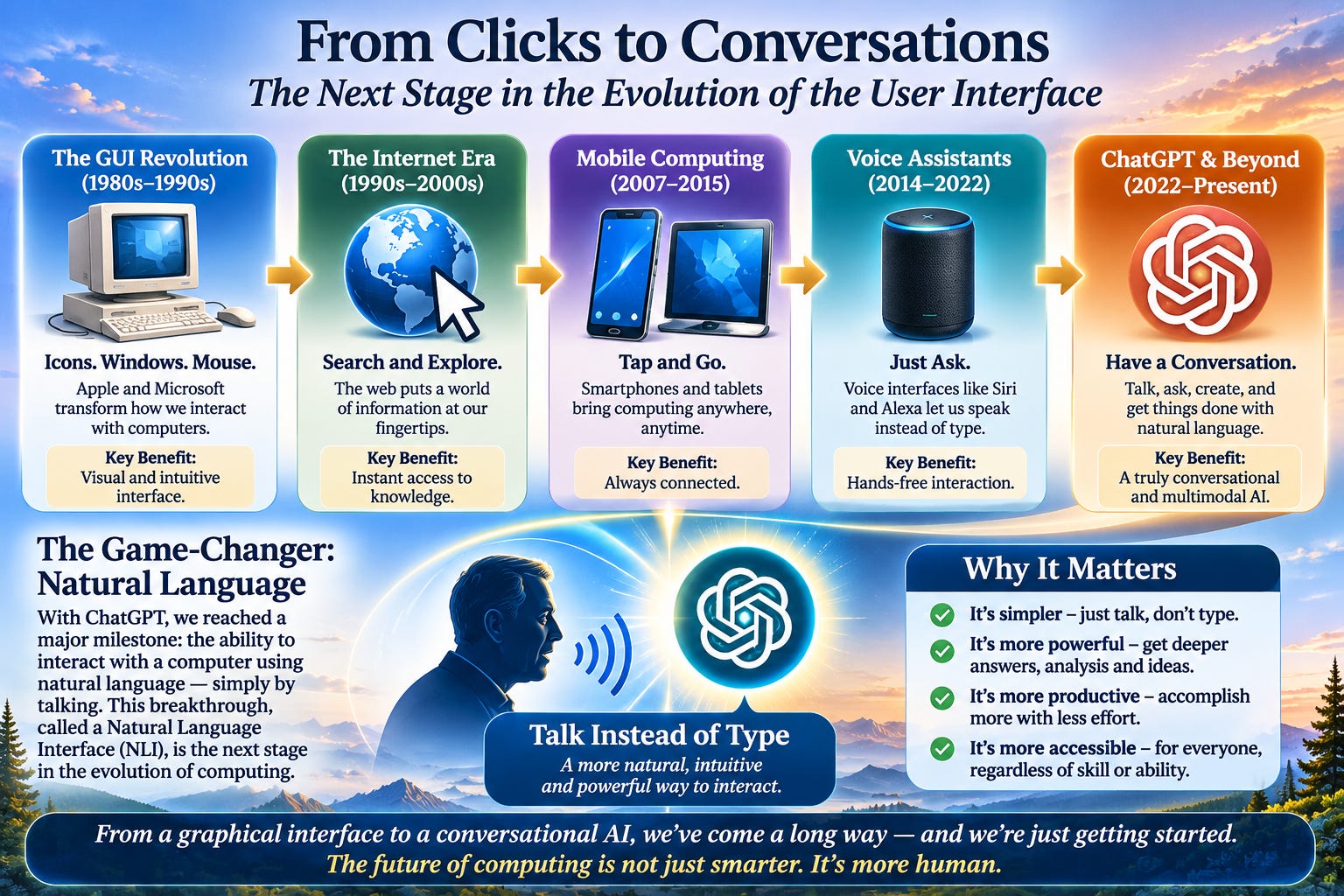
This distinction is especially important for anyone who remains skeptical or intimidated by artificial intelligence. Before considering its extraordinary capabilities in research, reasoning, writing, analysis, and problem-solving, consider the simplicity of the interface itself. You don’t need to understand programming, master complicated software, or even know precisely how to formulate your question. You can simply begin a conversation. And increasingly, you can speak rather than type. The computer can ask clarifying questions, interpret your intentions, and help you discover possibilities you might not have known existed. This represents far more than another software innovation. It is a fundamental change in the relationship between humans and computers, one that has the potential to make increasingly sophisticated technology accessible to virtually everyone.

Three historical nuances worth getting right…
First, Steve Jobs and Bill Gates were instrumental in popularizing graphical user interfaces, but they didn’t invent them. Much of the pioneering work happened at Xerox PARC in the 1970s. Apple’s Lisa (1983) and Macintosh (1984), followed by Microsoft Windows (1985), helped bring graphical interfaces to mainstream computing.
Second, ChatGPT’s original November 2022 release was a text-based conversational interface. You still needed a keyboard. Natural voice conversations arrived later. The original breakthrough wasn’t eliminating typing; it was eliminating much of the need to learn specialized computer commands.
Third, natural-language interfaces existed before ChatGPT, including Siri and Alexa. What changed was the flexibility and breadth of the interaction. Instead of issuing a limited set of predefined commands, people could engage in open-ended conversations.