


This is a preview of a more substanitive paper that will be published on this Substack channel soon…
What happens when the technology advances faster than our ability to comprehend it?
Artificial intelligence is advancing at an extraordinary pace. But our understanding of it, our willingness to embrace it, and our ability to put it to productive use are moving at very different speeds.
And those differences may be just as consequential as the technology itself.
Over the past several months, I’ve been exploring a fundamental question: What happens when technological capabilities advance faster than individuals, organizations, markets, and institutions can understand, adopt, and adapt to them?
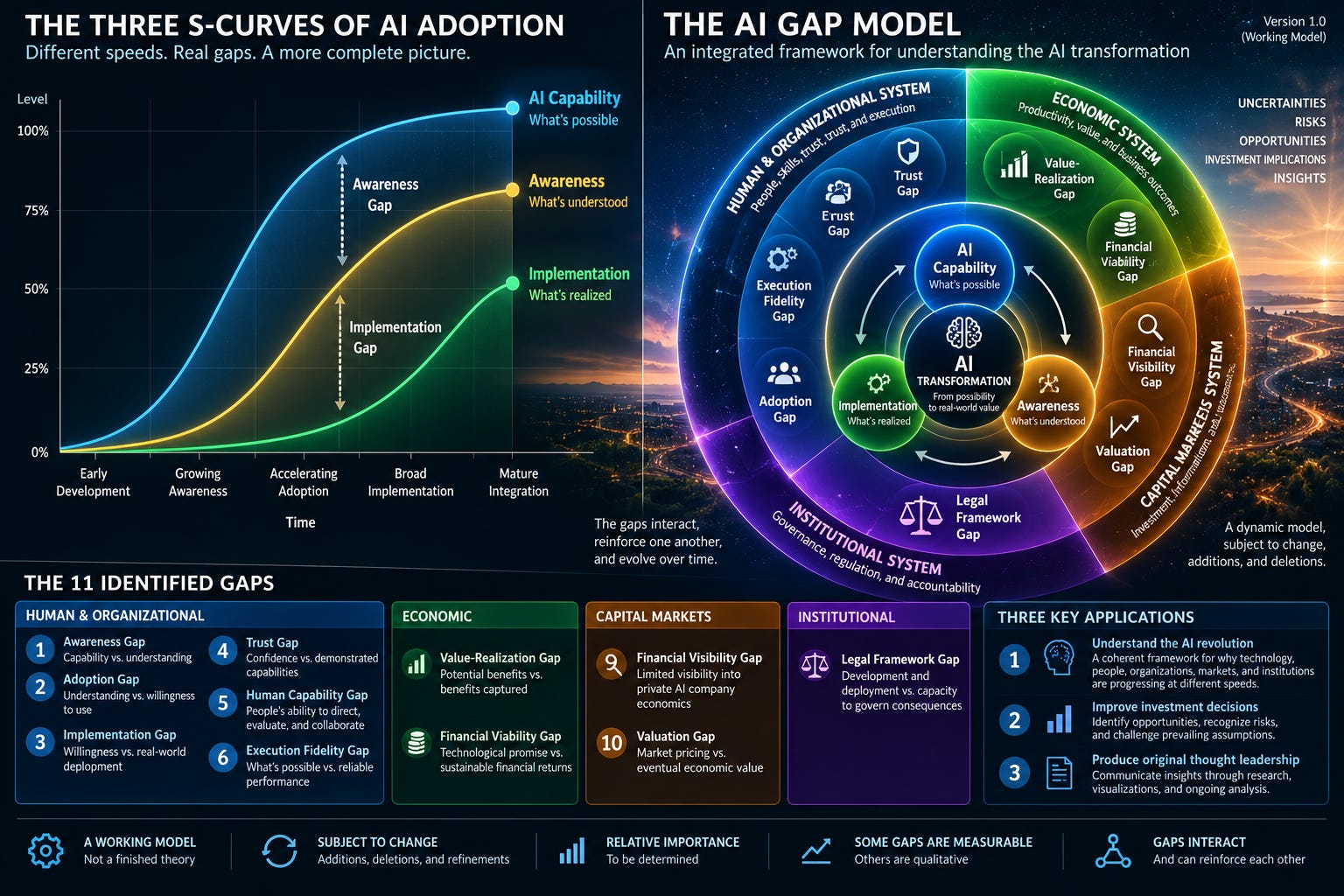
That exploration has evolved into The AI Gap Model, a working framework identifying 11 interconnected gaps across four major systems: human and organizational, economic, capital markets, and institutional.
At its foundation are three S-curves representing AI capability, human awareness, and real-world implementation. Together, they illustrate a central premise: The AI revolution isn’t unfolding at one speed. It’s unfolding at many speeds simultaneously.
These gaps create friction, uncertainty, risks, and extraordinary opportunities. They also help explain why perceptions of AI’s progress can differ so dramatically from its actual capabilities.
The model is a work in progress, not a finished theory. My intention is to share it openly, invite criticism and collaboration, and refine it as the transformation unfolds.
Coming soon to Deep Gap Journal: A deeper exploration of the AI Gap Model, its implications for society and capital markets, and what it might reveal about the road ahead.
This is a preview of a more substanitive paper that will be published on this Substack channel soon…
#ArtificialIntelligence #AIGapModel #TechnologicalDisruption #Innovation #DeepGapJournal